
What VINELink Covers in Calhoun County
VINELink is the public face of VINE, a free automated custody notification service, and Alabama runs its version under the name AlaVINE. County agencies call it a free, confidential way to find out whether someone is still in custody after an arrest and to get notice when that status changes. The search lives on the Alabama page of VINELink and accepts a name or an identifying number. It serves victims, families, and neighbors. It was never built to serve as an arrest log. Coverage is the real question. Alabama's House Joint Resolution 285, passed in 2024, admits the state has no universal notification system covering every county and local offender, and that counties without funding can go unserved. The Calhoun County Sheriff's Office roster, jail page, and contact page neither link an AlaVINE feed nor promise that every county booking is enrolled. Absence of a link is not proof of absence. Participation shifts with funding. The smart move is simple: open the Alabama search screen and check the county selector when you search. If Calhoun County is missing, or the person does not appear, fall back on the sheriff's roster and the jail information line. Scope matters too. VINE covers participating county jails and state prison systems, so a record can follow a person into a state facility. Federal custody sits outside it. Someone held for the U.S. Marshals Service, moved to the Federal Bureau of Prisons, or detained by immigration authorities will not show up in an Alabama result, and separate federal searches handle those cases.
How to Check a Calhoun County Arrest on VINELink
The check takes only minutes. Skip the national home page and start from the state person search, since that link loads the right filters and saves a step. Enter a full name, or an identifying number if the form asks for one. Keep the person's rough age in mind, because common names return long lists. Then follow the steps in order.
- Open the Alabama person search on VINELink and confirm the state selection reads Alabama.
- Enter the person's full name, or an ID number if one is already known.
- Narrow the list with any filters offered, such as a county or facility choice.
- Review each match against details you trust, like the person's age or middle initial.
- Open the custody record for the match that fits and read the status as of that moment.
Expect multiple matches, especially with common surnames. Resist grabbing the first result. Compare each entry's age, middle initial, or holding facility against what you already know, and set aside any record that does not line up. When two results look close, treat both as unconfirmed and call the jail before acting on either. For the booking record itself, meaning booked charges, bond amounts, and the records request path, the county-wide arrest guide walks through the sheriff's roster and its detail pages. The participation question answers itself on the search screen: the official VINELink Alabama person search.
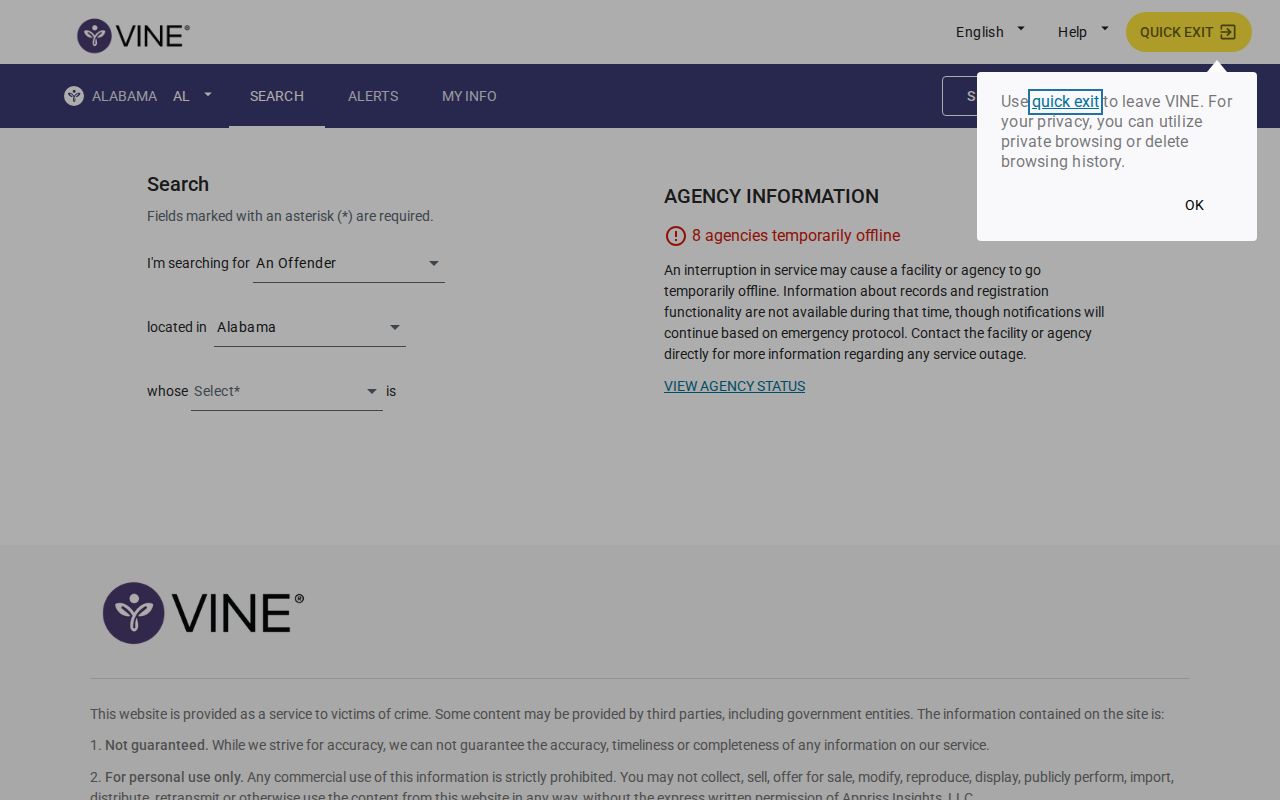
The search form itself settles the coverage question, since it is the right moment to confirm Calhoun County appears among the offered counties. Note: A person missing from VINE is not necessarily out of custody, because the county may not feed the service at all.
What VINELink Shows After an Arrest
A VINE record is thin on purpose. It answers the custody question and stops there, which makes it fast to read but limited as a document. Each result pulls a short field set from the participating agency's data feed, and nothing in it explains the case behind the arrest. Read what you see as a snapshot of one day, not a history of the matter. The table lists the fields a Calhoun County reader is most likely to meet.
| Field | What it shows |
|---|---|
| Custody status | Whether the person is reported in custody or not, as stated by the participating agency on its latest feed. |
| Holding facility | The jail or correctional facility the agency lists as holding the person. |
| Offender or ID number | An internal VINE identifier for the record. It is not the jail booking number. |
| Alert registration status | Whether notifications are active on the record and through which contact method. |
Those fields move when custody moves. A release flips the status line and fires the alerts you registered for. A transfer works the same way, with the old facility dropping the record and the new one picking it up. That handoff can leave a gap of a few hours while the status reads oddly. Timing belongs to the agency's data feed, not to VINE, so a result can lag the jail's own records after a fresh booking or a sudden release. When the answer matters within the hour, call the jail.
How to Register for Custody Alerts
Registration is the second half of a custody check. It is the half that works while you sleep. Alerts cost nothing, and sign-up happens from the person's own record, so finish the search first. A registration tells the service to reach out when custody changes through a release, a transfer, or another reported event. No reliable internet? Register by phone at the toll-free line 1-877-846-3425, or use the TTY line 1-866-847-1298 if you need it.
- From the person's custody record, choose the option to register for notifications.
- Pick a contact method: phone, email, text message, or TTY.
- Enter the contact details exactly as the screen requests them.
- Create a PIN or note the confirmation the system returns, and keep both private.
- Answer or confirm the test contact or first notification when it arrives.
One security detail matters here: the PIN. When an alert goes out, the PIN proves the reply came from the person who actually registered. Guard it. Treat any confirmation number the same way. Timing also varies, since each participating agency feeds its own data, so an alert may lag behind the custody change it describes.
Note: Registration only watches one person's custody status; it creates no case record.
Alabama's Two Notification Layers
Alabama splits notification into two layers, and confusing them wastes time. The county layer is AlaVINE, reached through the VINELink search. It tracks people held in participating county jails while a case is pending. The state layer works differently. The Alabama Victim Notification System follows people convicted and sentenced to state prison, and the state site redirects pretrial questions back to the county sheriff. As a case moves from arrest toward sentencing, a person can cross from one layer into the other.
The official Alabama Victim Notification System site spells out that scope on its own terms.
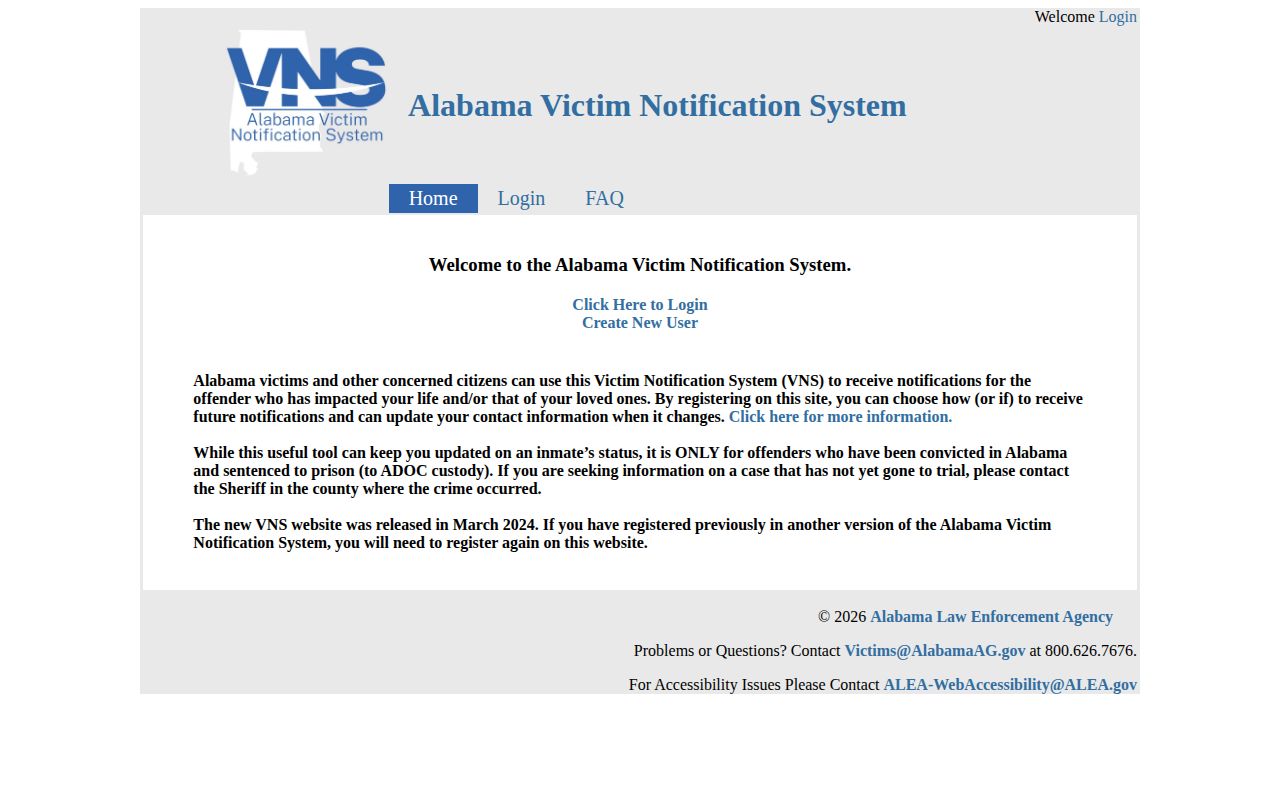
Registration does not carry across the divide. A county alert stops following someone once they enter state custody, and a state registration says nothing about a county hold. So when a case ends in a prison sentence and a transfer, families who want continued notice must register again with the state. When no website settles the question, the Calhoun County Sheriff's Office contact page lists the jail information lines. One call usually closes what a search leaves open.
Elsewhere in the state, counties write their own explainers. The Shelby County District Attorney's public page offers one example covering AlaVINE.

That page lays out a free, confidential service with sign-up by phone, email, text, or TTY.
Farther south there is a second example. The Escambia County Sheriff's AlaVINE page walks readers through search and registration under the state branding. Why should a Calhoun County reader care? Because those pages show what open participation looks like. The Calhoun County Sheriff's Office publishes no matching notice, so the county selector inside VINELink, not a sheriff's webpage, remains the thing to check.
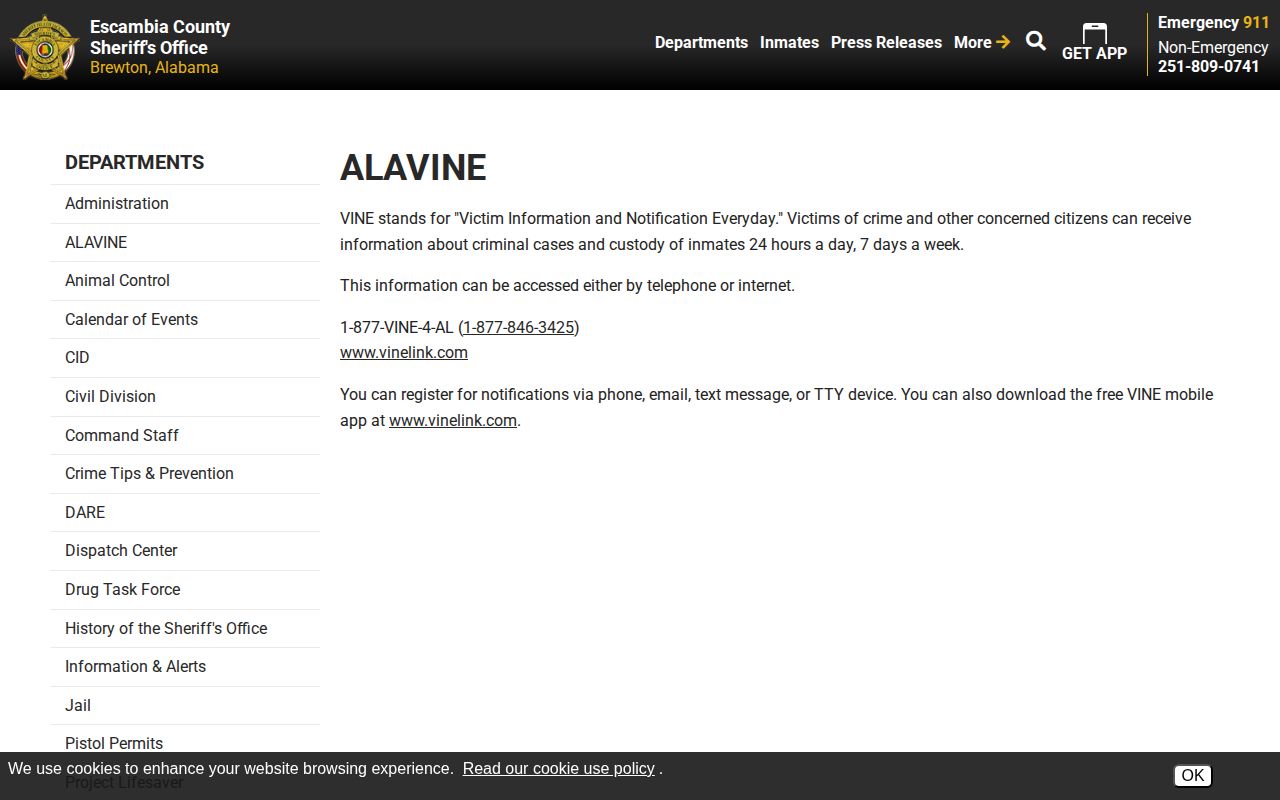
Reading one county's explainer first makes it easier to spot where another county's record trail goes quiet.
Note: State registration applies only after sentencing, so pretrial custody questions belong with the county sheriff.
VINELink Limits and How to Confirm
Start with what VINE cannot do. It has no federal coverage at all. Anyone held on federal charges, housed in federal prison, or detained by immigration stays invisible in an Alabama result. Federal custody runs through its own free systems. The BOP inmate locator covers federal prison custody going back to 1982, and the ICE Online Detainee Locator handles immigration detention. Neither one talks to VINE.
The county side has gaps too. A fresh booking can take time to appear, because VINE passes along only what the participating agency sends. And a result shows no charges and no bond amount. It cannot tell you why someone was arrested or what release costs. The daily arrest report view of the sheriff's roster carries both details as booked, and the jail information lines at 256-236-5561 and 256-241-8032 answer direct custody questions.
None of this makes the service useless. It just makes it one tool among several. Let the alert deliver notice, the roster supply the record, and the phone give the answer of the moment.
Verify the number before you share it. A frequently called numbers list also shows 256-241-8023 for the jail, and the sheriff's published numbers do not fully agree. Confirm the current line with the office, and treat any single VINE result as a lead to confirm rather than a final word.
An Alert Is Not an Outcome
A release alert can feel like an ending. It is not. The notification says custody changed, nothing more. A custody status moves a person between buildings; only the court docket moves a case toward an outcome.
So follow the case in the court file, not the custody feed. The Calhoun County Circuit Clerk holds the docket for the Seventh Judicial Circuit, and the clerk's public access tools show filings, hearings, and dispositions. The county-wide guide ties the arrest record, the roster, and the court path together for anyone who wants the full trail.